
For as long as online search has existed, Search Engine Optimisation (SEO) has helped businesses get found. The goal was straightforward: rank well on Google and get the right people to your website.
That's changing. And for many businesses, the impact is already showing - in website traffic, in how customers research and in how visible brands are online.AI tools such as Google AI Overviews, Microsoft Copilot, ChatGPT, Claude and Perplexity are reshaping how people find information. Instead of scrolling through a page of results, users are asking questions and getting direct answers instantly. A 2025 Pew Research study found that users were significantly less likely to click through to external websites when AI-generated summaries appeared in Google search results.
For marketing teams, this creates a new challenge.
The question is no longer just "How do we rank more highly on Google?" It's "How do we become the trusted source AI tools choose to reference?" And, perhaps more importantly: "Does our marketing team have the skills to adapt?”
What Is Answer Engine Optimisation (AEO)?
Answer Engine Optimisation (AEO) is the process of structuring and creating website content so that AI-powered search tools can understand it, trust it and use it when responding to user questions.
Traditional SEO focused on improving rankings and driving traffic through search engines. AEO shifts the focus. Rather than users scrolling through links to find information themselves, AI tools are now providing direct answers. That means businesses need content that is clear, well structured, credible and genuinely useful — content that AI systems can easily understand and confidently reference.
For many businesses, visibility is becoming more closely linked to whether their content is recognised as a reliable source within AI-generated results.
Why Does AEO Matter in 2026?
AI-driven search is already influencing how people research products, compare services and make buying decisions.
SEMrush reported in 2025 that visitors arriving through AI search converted at around 4.4 times the rate of traditional organic search visitors, suggesting that AI-assisted users are often further along in the buying journey and searching with clearer intent; valuable traffic for marketing teams.
| Website visitors arriving through AI search convert at 4.4 x those of organic search engine visitors |
Adobe’s 2026 reporting showed AI-driven traffic to US retail websites increasing sharply year on year, pointing to a clear shift in how product discovery and online research are already happening.
Businesses may receive fewer clicks from simple informational searches, but stronger opportunities to appear in front of people who are closer to making a decision - if your content is being referenced by AI tools in the first place.
Is SEO Moving Beyond Keywords?
Keywords still matter, and businesses should absolutely continue creating content around relevant search terms. But search engines are becoming far better at understanding context, meaning and intent rather than simply matching exact phrases.
That means businesses can no longer rely on:
- Repetitive keyword usage
- Generic AI-written blogs
- Low-value content created mainly to chase rankings rather than help customers
- Isolated landing pages with little supporting information
Instead, businesses need to demonstrate expertise across wider subject areas through helpful, relevant content written for humans not search engines.
What Does AEO Look Like in Practice?
This matters most in sectors where trust and research play a significant role in the decision-making process.
Take the care sector as an example. A care provider may previously have focused on ranking web pages for searches such as:

- “care home in Sheffield”
- “residential care services”
But potential customers are now asking broader, more conversational questions such as;
- “How do I know if my parent needs residential care?”
- “What is the difference between residential and nursing care?”
- “Are there waiting lists for care homes in Sheffield?”
- “What questions should I ask during a care home visit?”
Families researching care are often making emotional, high-stakes decisions. Businesses that create content that answers these questions clearly are more likely to build trust early in the decision-making process. This is especially true when they use the real questions, local research terms and location-specific phrases that people actually search for, such as “choosing a care home in Sheffield”.
This approach helps businesses connect with potential customers more effectively and also improves visibility within AI-powered search tools.

Take another example for homebuilding.
A housebuilder may want visibility for:
- “new homes in Derbyshire”
- “new build homes near Nottingham”
But buyers are asking broader, research-led questions such as:
- “What should I check before buying a new build?”
- “Are new builds more energy efficient?”
- “What new build upgrades are worth paying for?”
Creating useful content around these questions gives businesses more opportunities to appear in AI search results, while building trust earlier in the customer journey.
What Does Good AEO Content Look Like?
For most businesses, AEO comes down to three practical areas:
1. Clarity
Clarity matters because AI tools are looking for direct, easy-to-understand information. Reviewing your website structure so that key information is easy to find and easy to interpret is a good starting point.
2. Consistency
AI tools gather information from multiple sources. It is worth checking whether your website, LinkedIn page, Google Business Profile and any online listings all present accurate and consistent information so platforms can confidently understand and reference your business.
3. Credibility
AI search tools prioritise content that demonstrates real sector knowledge. Businesses creating original insight, practical guidance, case studies and evidence-based content are far more likely to build authority than those relying on generic, repetitive copy.
If your business is already creating useful content, answering customer questions and demonstrating expertise, you have already made a start.
What Impact Is AI and AEO Having on Marketing Teams?
One of the most common mistakes businesses are making around AI and search is that thinking they just need to produce more content faster. In reality, AI is often exposing weak marketing rather than rewarding volume.
Businesses producing customer-focused guidance, expert and well-structured content are far more likely to gain visibility than those pushing out large quantities of generic material. Most of us have started to notice the tell-tale signs of over-reliance on AI in content, including the sudden surge in em dashes appearing in everything.
Content that feels repetitive, generic or disconnected from the brand becomes obvious quickly, both to users and increasingly to search platforms themselves.
Used well, AI can help teams work more efficiently; improving content structure, generating ideas and strengthening copy. But AI works best when the team using it understands their audience, their tone of voice and what their customers need. Teams that skip that thinking are becoming easier to spot.
This is one reason we are seeing growing interest in our digital marketing skills bootcamps and strategic marketing apprenticeships as businesses try to keep up with how search and customer behaviour are changing.
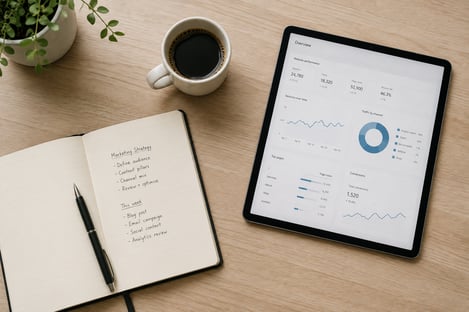
HOW DO YOU MEASURE AEO PERFORMANCE?
AI visibility is currently much harder to measure than traditional SEO performance.
Traditional SEO reporting focuses on rankings, clicks and website traffic. Google Search Console currently includes AI search traffic within broader web search reporting rather than separating it out. Microsoft Bing now offers more dedicated AI visibility reporting, including citations and visibility trends. Measuring visibility within tools such as ChatGPT remains limited.
For now, most businesses need to rely on a combination of referral traffic analysis, manual testing and monitoring how their content appears within AI-generated responses.
That means marketing teams need to think beyond standard SEO reporting and start asking wider questions:
-
Where is the brand appearing?
-
How is content being referenced?
-
Are AI tools presenting the business accurately?
- Which content is influencing customer decisions?
What Should Businesses Be Doing Now?
A good starting point is reviewing whether your current content helps customers make decisions, not just whether it targets the right keywords.
Practically, that means:
- Answering the questions customers ask before they buy
- Making sure business details are consistent across your website, LinkedIn and online listings
- Structuring pages so both users and AI tools can navigate and understand them easily
- Demonstrating genuine expertise and experience rather than publishing for the sake of it
- Measuring outcomes beyond rankings and traffic alone
Businesses adapting well are typically investing in useful, answer-ready content: practical buyer guides, FAQs based on real customer questions, comparison content, case studies and expert commentary. Many are also reviewing how their websites are structured so information is easier to find and reference.
One of the biggest mistakes businesses can make is treating AEO as simply the latest marketing trend. Businesses with weak positioning, inconsistent messaging or unclear targeting are unlikely to perform well in AI search regardless of how much content they publish. The major platforms are reinforcing many of the same principles that good marketers have been applying for years.
Clear website structure, trustworthy content, accurate business information and meaningful measurement still matter - now perhaps more than ever.
DOES YOUR MARKETING TEAM HAVE THE STRATEGIC CAPABILITY NEEDED?
This is where the conversation becomes much bigger than SEO. Performing well in AI-driven search requires more than simply publishing content regularly. It requires marketing teams that understand customer behaviour, commercial priorities and how digital visibility connects to wider business goals.
Many organisations already have marketers who are strong operationally. They can manage campaigns, social media, websites and content production effectively. But as search changes, the gap between tactical delivery and strategic marketing capability is becoming more obvious.
Questions such as:
-
What information are customers looking for before they buy?
-
Which content helps build trust and supports decision-making?
-
Is the business building authority in its sector or simply producing more content?
-
How is marketing activity contributing to commercial outcomes?
These are becoming more important as AI-driven search develops, and they require marketers who can combine customer insight, content, analytics and commercial understanding.
Programmes such as the Level 6 Marketing Manager apprenticeship help marketers develop skills in areas such as strategic planning, customer insight, analytics, leadership and decision making; all becoming more valuable as AI continues to reshape digital marketing.
This is one reason more employers are looking to strengthen marketing capability internally rather than relying entirely on agencies or AI tools. Programmes such as the Level 6 Marketing Manager apprenticeship help marketers build skills in strategic planning, analytics, customer insight, leadership, campaign management and decision making. These are all areas becoming more valuable as AI continues to reshape digital marketing.
Is Your Business Ready for AI-Driven SEARCH?
We’re already seeing this shift through conversations with employers. Businesses are not just looking to improve digital marketing skills within their teams, they want marketers who can think strategically, understand emerging technology and connect marketing activity to wider business goals.
Search is shifting from links to answers. Websites still matter, but what's changing is the need for businesses to become trusted sources of information that AI tools can confidently reference.
Visibility in AI-driven search is unlikely to belong to businesses simply producing the most content. It is more likely to belong to those that understand their audience, answer customer questions clearly and have the marketing capability to adapt as search continues to evolve.
If you would like to talk about how Ascento can help your marketing team build that capability, get in touch.
The images accompanying this post were created using AI





Join the conversation