
Looking to develop your employees' skills but unsure what government funding is available? From fully funded apprenticeships for under-25s to financial support for recruiting new staff, here's what your business needs to know.
Investing in your employees' skills is important, but finding the budget for training isn't always straightforward.
The good news is that government funding is available to help businesses develop their employees, whether you're a small business with a handful of staff or a larger organisation with an established training programme.
And you don't need to recruit a new starter to benefit. Apprenticeships can also provide structured, funded development for existing employees.
With important changes to apprenticeship funding introduced in 2026, we've answered some of the questions employers most frequently ask about accessing funded training.
This guide covers apprenticeship funding in England. Different arrangements apply in Scotland, Wales and Northern Ireland.
1. Can I get government funding to train my existing employees?
Yes!
Government-funded apprenticeships aren't just for new recruits or school leavers.

Existing employees can undertake an apprenticeship, provided the programme is appropriate for their role, offers substantial new learning and meets the relevant eligibility requirements.
For example, you might have:
- A marketing assistant who needs to develop their digital marketing and AI skills.
- An administrator taking on wider business responsibilities.
- An employee developing the skills needed to become fully competent in their occupation.
Rather than paying for a series of separate training courses, an apprenticeship provides a structured development programme that combines learning with practical workplace application.
The amount of government funding available depends on factors including your employee's age and whether your business pays the Growth and Skills Levy.
2. Can employees under 25 access fully funded training?
Yes!
One of the most significant changes that's come about in 2026 is the availability of 100% government funding for eligible apprentices aged 16-24.
Now for businesses that don't pay the levy (most SMEs), the government covers the eligible apprenticeship training and assessment costs up to the funding band maximum.
For levy-paying employers whose apprenticeship funds have run out, the government also covers 100% of eligible costs for apprentices in this age group.
This means that employers can develop younger employees without contributing towards their apprenticeship training costs.
However, employers still need to provide appropriate workplace support, time for training and any employment-related costs.
What could this mean for your business?
If you already employ someone aged 16-24 who would benefit from developing their marketing, administration or leadership skills, it could be worth checking whether a suitable apprenticeship is available. Already we’re seeing increasing numbers of junior employees enrolling on our Level 3 Business Skills for Emerging Leaders and Multi-Channel Marketer apprenticeships
3. What funding is available for employees aged 25 and over?
Government funding is also available for employees who are aged 25 and over.
For businesses that don't pay the levy, the government contributes 95% of eligible apprenticeship training and assessment costs, with the employer contributing 5%.
For levy-paying employers, apprenticeships are normally funded through their apprenticeship service account.
Here's how the funding works:
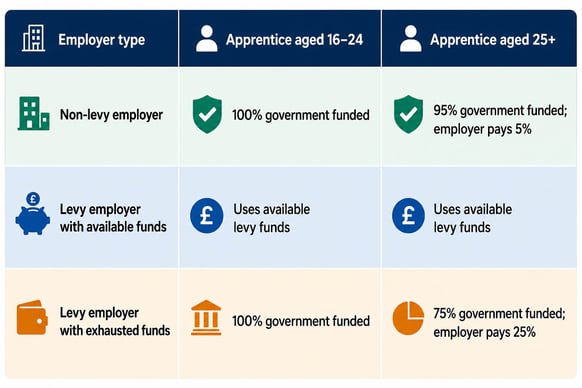
Funding is subject to eligibility and the apprenticeship funding band maximum.
For a small business, this can make developing existing employees considerably more affordable than funding training independently.
For example, if an eligible apprenticeship costs £10,000, a non-levy employer training an employee aged 25 or over would contribute £500, with the government contributing £9,500.
4. Is there funding available if I recruit a new employee?
Yes!
From 1st October 2026, eligible non-levy-paying employers can receive a £2,000 hiring payment when recruiting a new apprentice aged 16-24.
To qualify, the apprentice must have been employed for no more than 90 days before starting their apprenticeship. This is in addition to the eligible apprenticeship training costs being fully funded by the government.
For example, a small business recruiting a new marketing assistant could potentially access fully funded apprenticeship training and receive the additional £2,000 hiring payment, subject to meeting the scheme's requirements.
Additional payments of £1,000 may also be available for employers recruiting apprentices aged 16-18, or eligible apprentices aged 19-24 with an Education, Health and Care plan or care experience.
5. Does my business need to pay the apprenticeship levy to access funding?
No!
Businesses of all sizes can access government-funded apprenticeships.
If your business doesn't pay the levy, you can still access government funding for eligible apprenticeship training.
For employers that do pay the levy, funding is managed through an apprenticeship service account.
There have been three important changes for levy-paying businesses in 2026:
The 10% government top-up has ended. New levy funds entering employer accounts from 1st August 2026 no longer receive the additional 10% government top-up.
Employer contributions have changed when levy funds run out. For new apprenticeship starts from 1st August 2026, levy-paying employers with insufficient funds contribute 25% towards eligible training and assessment costs for apprentices aged 25 and over, rather than the previous 5%.
New levy funds expire sooner. Funds entering accounts from 1st August 2026 expire after 12 months, while earlier funds retain their original 24-month expiry period.
For larger organisations, these changes make it particularly important to review future apprenticeship requirements and available funding.
6. What types of training can my employees access?
Apprenticeships are available across a wide range of occupations and levels, from entry-level roles to more experienced positions.
At Ascento, we specialise in developing practical workplace skills, including:
Marketing
Supporting employees to develop the knowledge and skills needed to plan, deliver and evaluate marketing activity.
We offer three levels of Marketing apprenticeship: Level 3 Multi-Channel Marketer,Level 4 Marketing Executive and Level 6 Marketing Manager.
Business administration and leadership skills
Helping employees develop their ability to manage business processes, communicate effectively and contribute to organisational performance. Check out our new Level 3 Business Skills for Emerging Leaders programme.
The right programme depends on the employee's existing knowledge, their job responsibilities and the new skills they need to develop. An apprenticeship must be appropriate for the occupation, rather than simply being selected because funding is available.
The Growth and Skills Levy also supports approved short apprenticeship units for existing employees aged 19 and over in selected areas, including AI leadership and technical skills.
7. Can employees complete an apprenticeship while working?
Yes!
Apprenticeships are designed to combine structured training with practical experience in the workplace.
Employees continue working in their roles while developing the knowledge, skills and behaviours required by their apprenticeship. Employers need to provide the appropriate time and support for training, including off-the-job learning during paid working hours.
In our experience, apprenticeships are particularly valuable when employees have opportunities to apply their learning to real workplace challenges.
For example, a marketing apprentice might develop a campaign for their organisation, while an employee developing their higher-level admin skills could apply new approaches to team communication and project management.
This helps employers see the practical value of training alongside the employee's progress.
8. Do employees need English and Maths qualifications to start an apprenticeship?
Not necessarily.
Under the updated rules, apprentices aged 19 and over are not automatically required to achieve English and Maths qualifications to complete their apprenticeship, unless these are specifically required by the apprenticeship standard.
For younger apprentices aged 16-18, the relevant English and Maths requirements continue to apply.
This greater flexibility may make apprenticeships more accessible to experienced employees who have strong practical skills but don't hold formal qualifications.
9. How do I access government funding for my employees?
You don't need to work out all the funding arrangements yourself.
We can help you understand the options and check whether your employees and proposed training meet the relevant requirements.
The starting point is to consider:
- What skills does your business need?
Identify current skills gaps, recruitment needs or opportunities to develop existing employees. - Who would benefit from training?
Consider their current role, experience and development requirements. - What funding could be available?
Check eligibility, the relevant apprenticeship funding band and any employer contribution. If you’re not sure, we’re happy to help. - Which programme is appropriate?
Choose training that provides substantial new learning and supports the employee's occupational development. - How will the learning work in practice?
Agree how the employee will be supported and given time to complete their training.
Find out what funded training your business could access
Whether you're planning to recruit, develop your existing employees or invest in your future managers, government-funded apprenticeships could help you achieve your workforce development goals.
At Ascento, we work with employers to understand their training needs, identify suitable programmes and explain the funding available.
Not sure what your business is eligible for?
Talk to our team about your employees, your skills requirements and the training opportunities available.
All funding information is based on the October 2026 updates and is subject to eligibility, programme requirements and applicable funding limits.





Join the conversation